
Summer School "Complex Networks: Theory and Practice" (part 2 of Thematic Semester "GRAPHS AND BEYOND")
Hanoi, 03/08/2026 - 08/08/2026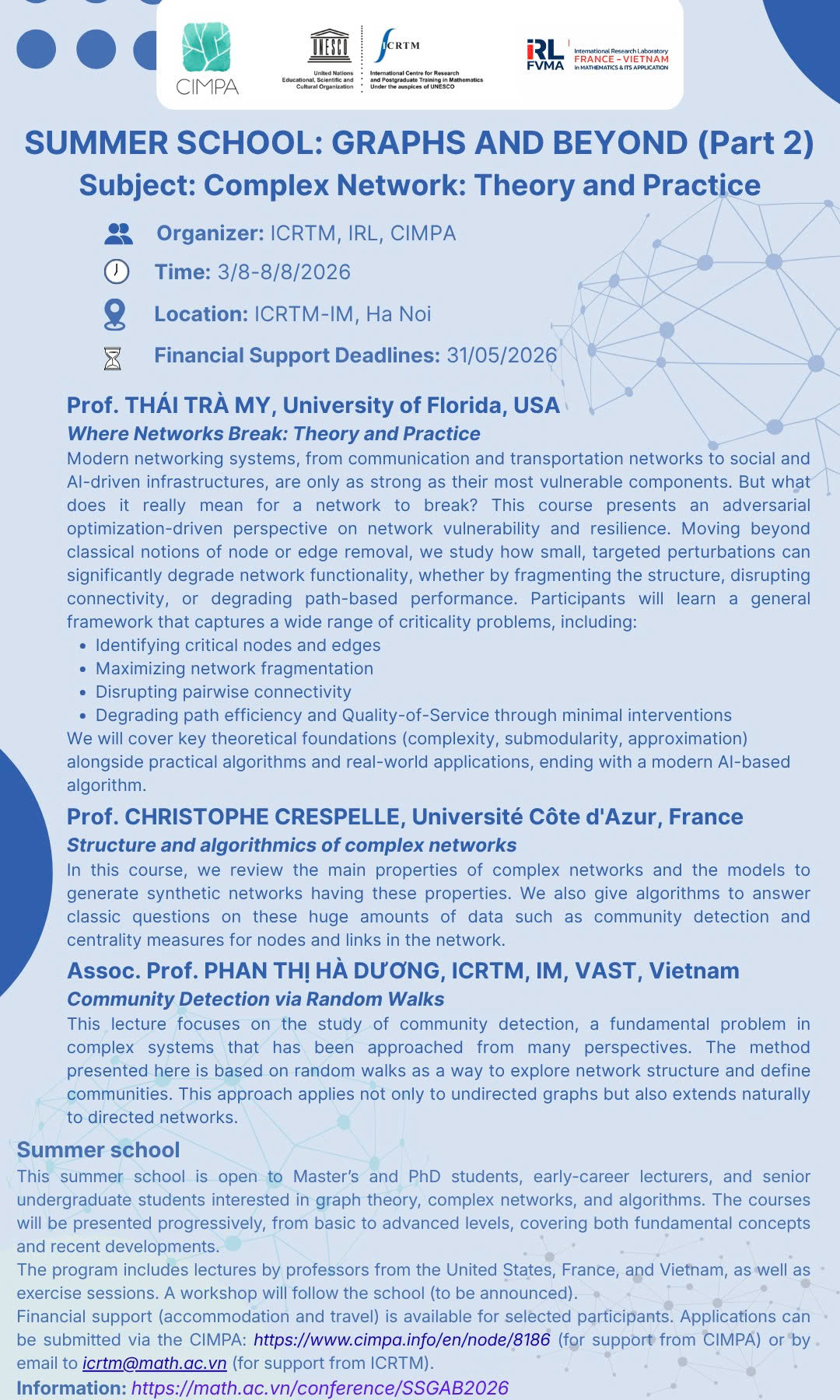
Subject: Complex Network: Theory and Practice
Organizer: ICRTM, IRL, CIMPA
Time: 3/8-8/8/2026
Location: ICRTM-IM, Ha Noi
Financial Support Deadlines: 31/05/2026
Prof. THÁI TRÀ MY, University of Florida, USA
Where Networks Break: Theory and Practice
Modern networking systems, from communication and transportation networks to social and AI-driven infrastructures, are only as strong as their most vulnerable components. But what does it really mean for a network to break? This course presents an adversarial optimization-driven perspective on network vulnerability and resilience. Moving beyond classical notions of node or edge removal, we study how small, targeted perturbations can significantly degrade network functionality, whether by fragmenting the structure, disrupting connectivity, or degrading path-based performance. Participants will learn a general framework that captures a wide range of criticality problems, including:
- Identifying critical nodes and edges
- Maximizing network fragmentation
- Disrupting pairwise connectivity
- Degrading path efficiency and Quality-of-Service through minimal interventions
We will cover key theoretical foundations (complexity, submodularity, approximation) alongside practical algorithms and real-world applications, ending with a modern AI-based algorithm.
Prof. CHRISTOPHE CRESPELLE, Université Côte d'Azur, France
Structure and algorithmics of complex networks
In this course, we review the main properties of complex networks and the models to generate synthetic networks having these properties. We also give algorithms to answer classic questions on these huge amounts of data such as community detection and centrality measures for nodes and links in the network.
Assoc. Prof. PHAN THỊ HÀ DƯƠNG, ICRTM, IM, VAST, Vietnam
Community Detection via Random Walks
This lecture focuses on the study of community detection, a fundamental problem in complex systems that has been approached from many perspectives. The method presented here is based on random walks as a way to explore network structure and define communities. This approach applies not only to undirected graphs but also extends naturally to directed networks.
Summer school
This summer school is open to Master’s and PhD students, early-career lecturers, and senior undergraduate students interested in graph theory, complex networks, and algorithms.
The courses will be presented progressively, from basic to advanced levels, covering both fundamental concepts and recent developments.
The program includes lectures by professors from the United States, France, and Vietnam, as well as exercise sessions. A workshop will follow the school (to be announced).
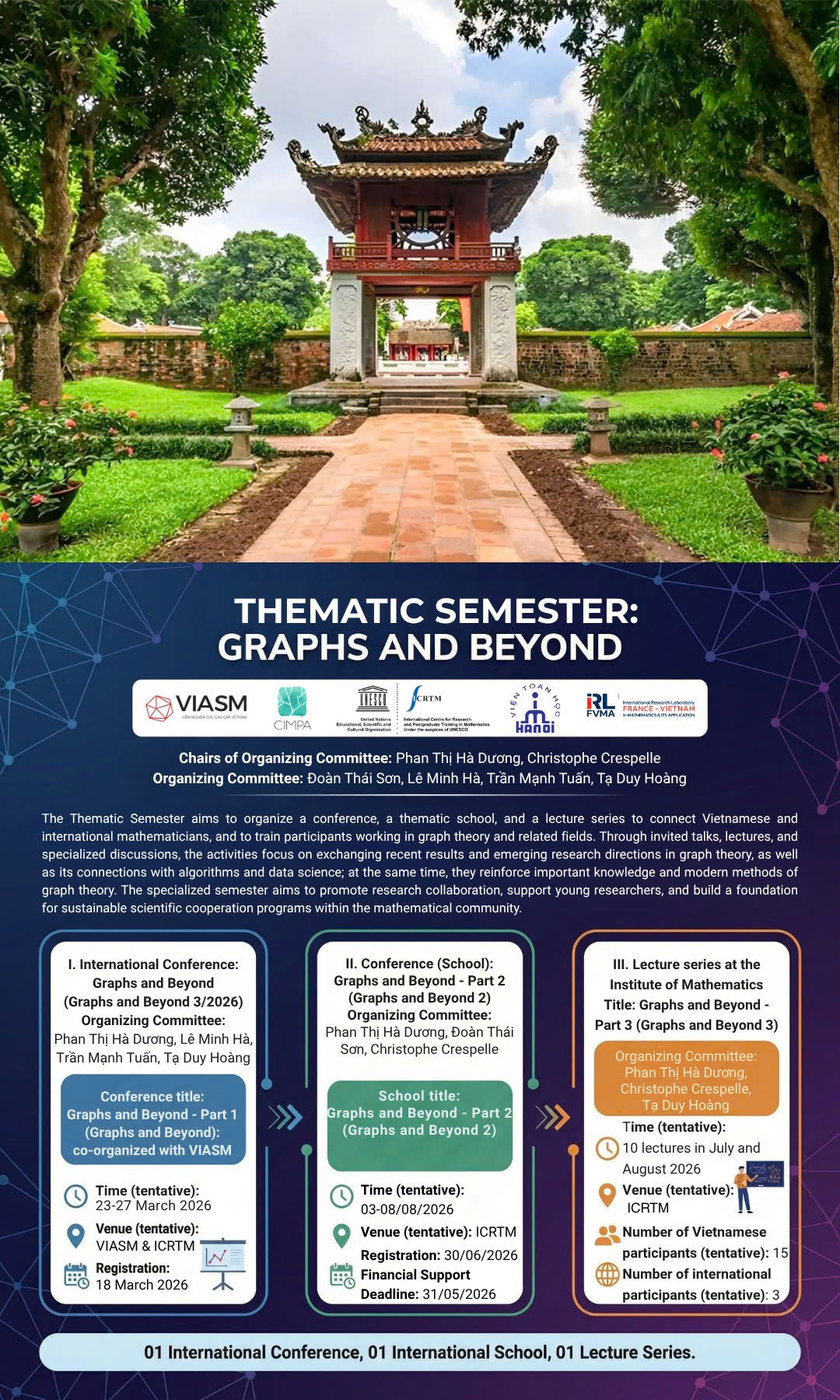
Part III of the Thematic Semester will consist of approximately 10 research seminars and working group sessions, to be held in July and August at ICRTM. Further details will be announced in due course.
Financial Support
Financial support (accommodation and travel) is available for selected participants.
Applications can be submitted:
- via CIMPA: https://www.cimpa.info/en/node/8186 (for support from CIMPA)
- or by email: icrtm@math.ac.vn (for support from ICRTM)
Financial support (accommodation and/or travel for participants coming from outside Hanoi) is available for a limited number of selected researchers and students.
Applicants may apply either for the Summer School (Part II) or for both the Summer School and the working group activities (Part III), which will take place during July and August 2026 as part of the thematic program.
More Information
School: https://math.ac.vn/conference/SSGAB2026
Thematic Semester: https://math.ac.vn/conference/GraphsBeyond2026
Financial Support
Financial support (accommodation and travel) is available for selected participants.
Applications can be submitted:
- via CIMPA: https://www.cimpa.info/en/node/8186 (for support from CIMPA)
- or by email: icrtm@math.ac.vn (for support from ICRTM)
Financial support (accommodation and/or travel for participants coming from outside Hanoi) is available for a limited number of selected researchers and students.
Click here to download the program.
Some pictures from summer school, please here