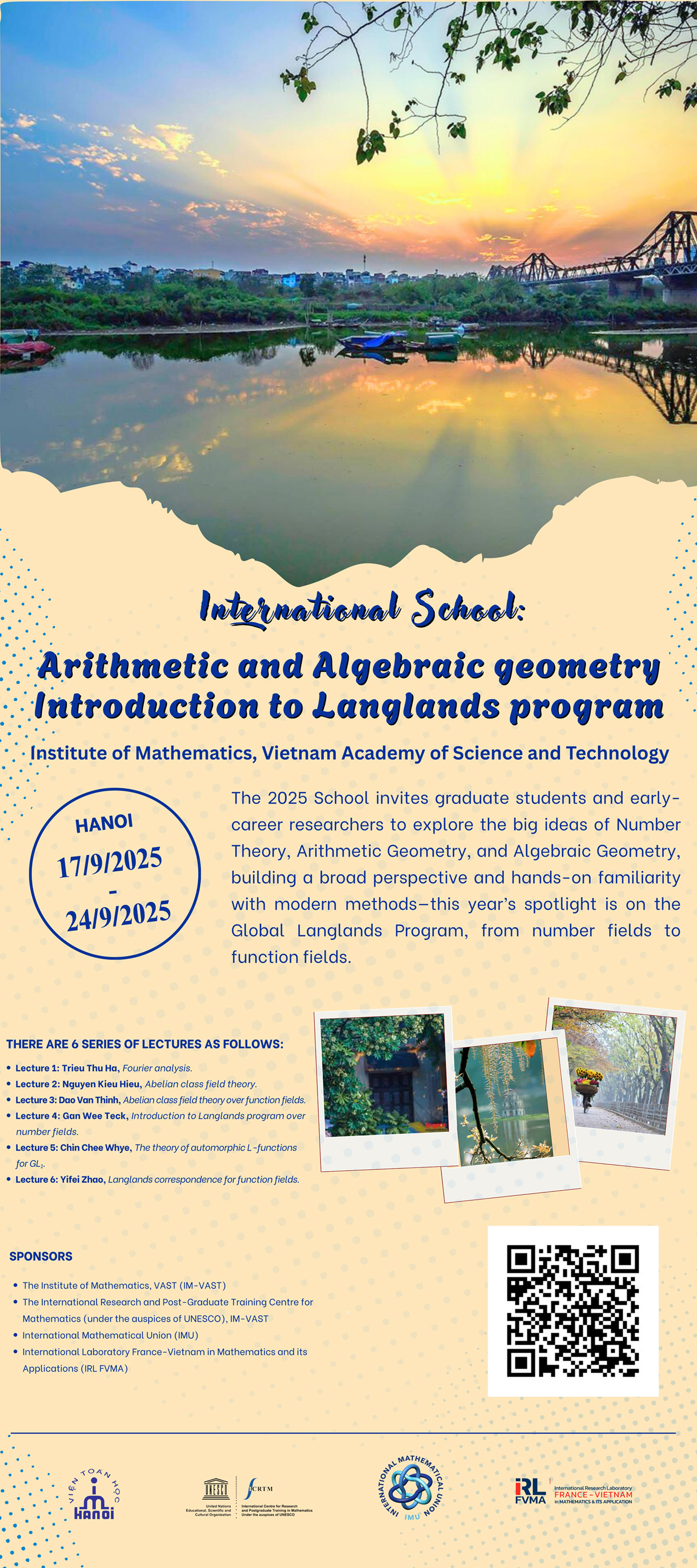
1. Gan Wee Teck (National University of Singapore)
Title: Introduction to Langlands program over number fields.
Abstract: In this short course, I will introduce Langlands program as a generalization of the class field theory. Here is my plan:
Lecture 1: Langlands program as non-abelian class field theory
Lecture 2: Local Langlands program
Lecture 3: Automorphic Forms and Global Langlands Program
Lecture 4: Arthur’s Conjecture on the Automorphic Discrete Spectrum
We concentrate on the case of general linear groups and do computations as much as possible. The main reference is [BK97] p245-302.
Reference:
[BK97] Bailey, T.N. and Knapp, A. W., editors, Representation Theory and Automorphic Forms, Proceedings of Symposia in Pure Mathematics Volume: 61; 1997; 479 pp.
2. Chin Chee Whye (National University of Singapore)
Title: The theory of automorphic L-functions for GL_1.
Abstract: There are two kinds of L-functions of one complex variable that are
associated with the situation of the Artin reciprocity, and they are essential to understand for the Langlands program. Each is a product over all places of elementary functions of s. An Artin L-function is associated with each finite Galois extension of k and finite dimensional complex representation of the Galois group, while a Hecke L-function is associated with each “Grossencharacter,” namely each one-dimensional character of the idele class group. Basically, an Artin L-function encodes certain arithmetic information (so people sometimes call it a ”motivic L-function), on the other hand, Hecke L-function encodes certain transformation-group behavior, in that it continues meromorphically to the complex plane and satisfies a functional equation relating its value at s to the value of a companion L-function at c-s for a certain c (so it is called an “automorphic” L- function).
In this series of lectures, I will cover Tate’s thesis which is about the theory of automorphic L-functions for GL_1. Here is my plan:
Lecture 1: overview, locally compact groups, Pontrjagin duality, Fourier analysis on locally compact groups, Poisson summation formula --- assuming knowledge of Lebesgue measure and integration theory, Haar measure, basics of Fourier analysis.
Lecture 2: local L-functions, local epsilon-factors and local functional equation --- assuming knowledge of local fields and the structure of their additive and multiplicative groups.
Lecture 3: global L-functions, global epsilon-function and their analytic properties --- assuming knowledge of global fields and the structure of their adele rings and idele groups.
If time permits I can also go beyond Tate’s thesis and talk about the “converse theorem” in the GL_1 case and other related results. The main reference is [Tat50].
Reference:
[Tat50] J.T. Tate. Fourier Analysis In Number Fields and Hecke’s Zeta-Functions. PhD thesis, Princeton, 1950.
3. Yifei Zhao (University of Muenster)
Title: Langlands correspondence for function fields.
Abstract: In these lectures, I will introduce the geometric Langlands program, especially the case of GL_2. This will be considered as a non-abelian class field theory over function fields. The main reference is [MV07].
Reference:
[MV07] Ivan Mirkovic and Kari Vilonen, Geometric Langlands duality and representations of algebraic groups over commutative rings, Ann. of Math. (2) 166 (2007), no. 1, 95–143.
4. Trieu Thu Ha (Hanoi University of Science and Technlogy)
Title: Fourier analysis.
Abstract: This is a preparation for the lecture of Chin Chee Whye. I will introduce some basic concepts in Fourier analysis such as Lebesgue measure, integration theory, and Haar measure. The main references are [Rud06], and [Tat50].
References:
[Rud06] W. Rudin. Real and Complex Analysis. Tata McGraw-Hill, third international edition, 2006.
[Tat50] J.T. Tate. Fourier Analysis In Number Fields and Hecke’s Zeta-Functions. PhD thesis, Princeton, 1950.
5. Nguyen Kieu Hieu (University of Versaile)
Title: Abelian class field theory.
Abstract: Abelian class field theory describes concretely the finite Galois extensions with abelian Galois group for a given base global field k. The global fields have two kinds: number field and function field. The references that dealt with both cases are [Cas67] (using an approach emphasizing completeness and cohomology) and [Wei73] (using an approach emphasizing the role of locally compact fields). After going through the basics of discrete valuation theory (completion, local field, discriminant, Dirichlet Unit theorem, and the finiteness of class number), the lecture will introduce Adeles and ideles which are convenient tools in preparation for abelian class field theory (see Chapter II in [Cas67]) which is built around Artin reciprocity, a generalization of Gauss’s quadratic reciprocity, which provides a bijection between the abelian Galois extensions of the global field k (up to k−isomorphism) and the open subgroups of finite index of the idele class group.
References:
[Cas67] Cassels, J. W. S., and A. Frohlich, Algebraic Number Theory, Academic Press, 1967.
[Wei73] Weil, A., Basic Number Theory, Springer-Verlag, 1973.
6. Dao Van Thinh (Institute of Mathematics, VAST)
Title: Abelian class field theory over function fields.
Abstract: This series of lectures is parallel to the lectures of Nguyen Kieu Hieu, but we will concentrate on the case of function fields. These are also served as a special case (GL_1) of Langlands program over function fields which is lectured by Yifei Zhao. Abelian class field theory for function fields is related to the geometry of curves, and this geometry is lost to some extent when number fields and function fields are treated together. The reference is [Ser88].
Reference:
[Ser88] Serre, J.-P., Algebraic Groups and Class Fields, Springer-Verlag, 1988.